Books in Neuroscience

Elsevier's Neuroscience collection empowers educators, researchers, and students with actionable knowledge to drive collaborative research and advancements in the field. Content covers the nervous system's intricate workings, covering branches like Affective, Behavioral, and Cognitive neuroscience to investigate the neural basis of emotions, behavior, and cognitive functions. Spanning from Molecular and Cellular Neuroscience to Developmental Neuroscience, content provides insights into brain function in health and disease.

  • Nerves and Nerve Injuries

    Vol 1: History, Embryology, Anatomy, Imaging, and Diagnostics
    • 1st Edition
    • R. Shane Tubbs + 5 more
    • English
    Nerves and Nerve Injuries is the first comprehensive work devoted to the nerves of the body. An indispensable work for anyone studying the nerves or treating patients with nerve injuries, these books will become the ‘go to’ resource in the field. The nerves are treated in a systematic manner, discussing details such as their anatomy (both macro- and microscopic), physiology, examination (physical and imaging), pathology, and clinical and surgical interventions. The authors contributing their expertise are international experts on the subject. The books cover topics from detailed nerve anatomy and embryology to cutting-edge knowledge related to treatment, disease and mathematical modeling of the nerves. Nerves and Nerve Injuries Volume 1 focuses on the history of nerves, embryology, anatomy, imaging, and diagnostics. This volume provides a greatly detailed overview of the anatomy of the peripheral and cranial nerves as well as comprehensive details of imaging modalities and diagnostic tests.
  • Sensorimotor Rehabilitation

    At the Crossroads of Basic and Clinical Sciences
    • 1st Edition
    • Volume 218
    • English
    This volume of Progress in Brain Research focuses on Sensorimotor Rehabilitation.
  • Stellate Cells in Health and Disease

    • 1st Edition
    • Chandrashekhar Gandhi + 1 more
    • English
    Stellate Cells in Health and Disease is a comprehensive reference providing the most up-to-date knowledge and perspectives on the function of stellate cells affecting the liver and other organs. The text presents comprehensive coverage of their already established role in hepatic fibrosis along with the newer emerging evidence for stellate cell participation in the liver cell (hepatocyte) survival and regeneration, hepatic immunobiology, transplant tolerance, and liver cancer. Chapters describe both animal and human research and the relevance of findings from animal research to human pathophysiology, and also contain sections on future directions which will be of special interest to basic and clinical researchers working on liver fibrosis, hepatic biology, and pathobiology.
  • TRP Channels as Therapeutic Targets

    From Basic Science to Clinical Use
    • 1st Edition
    • Arpad Szallasi
    • English
    TRP Channels as Therapeutic Targets: From Basic Science to Clinical Use is authored by experts across academia and industry, providing readers with a complete picture of the therapeutic potential and challenges associated with using TRP channels as drug targets. This book offers a unique clinical approach by covering compounds that target TRP channels in pre-clinical and clinical phases, also offering a discussion of TRP channels as biomarkers. An entire section is devoted to the novel and innovative uses of these channels across a variety of diseases, offering strategies that can be used to overcome the adverse effects of first generation TRPV1 antagonists. Intended for all researchers and clinicians working toward the development of successful drugs targeting TRP channels, this book is an essential resource chocked full of the latest clinical data and findings.
  • La maladie de Parkinson

    • 3rd Edition
    • Luc Defebvre + 1 more
    • French
    La maladie de Parkinson est, après la maladie d'Alzheimer, l'affection neurologique la plus répandue au sein de la population après 50 ans. Elle touche près de 2 % des personnes de plus de 65 ans. Ce pourcentage augmentant avec l'âge, on peut prévoir qu'avec le vieillissement de la population, le nombre de patients ne cessera d'augmenter dans les années à venir. La troisième édition de cet ouvrage, entièrement en couleurs, consacrée à la maladie de Parkinson rend compte de façon didactique des avancées de ces cinq dernières années, en abordant de façon exhaustive tous les aspects de cette pathologie : l'épidémiologie, l'étiopathogénie, les aspects génétiques, la physiopathologie, les signes moteurs et non moteurs, notamment les troubles cognitifs, psychiques et comportementaux. De nouveaux chapitres dédiés aux troubles psychiatriques et du comportement, à l'éducation thérapeutique, les biothérapies, la neuropathologie et la procédure de reconnaissance comme maladie professionnelle viennent compléter cette monographie. Dans cet ouvrage, sont également mis à jour les critères diagnostiques, les échelles et questionnaires d'évaluation, la place de l'imagerie morphologique et fonctionnelle enfin les stratégies thérapeutiques actuelles : médicamenteuses, chirurgicales, rééducatives et orthophoniques.
  • Headache and Migraine Biology and Management

    • 1st Edition
    • Seymour Diamond + 4 more
    • English
    There are two crucial issues in the treatment and management of headache patients: More than 50% of individuals experiencing headache have only been treated symptomatically, with no appropriate diagnosis established; and history and neurologic examination are essential to establishing a diagnosis, and thus selecting appropriate therapy. Headache and Migraine Biology and Management is a practical text that addresses these issues, featuring contributions from expert clinical authors. The book covers in detail topics including chronic and episodic migraine, post-traumatic headache, sinus headache, cluster headache, tension headache, and others. Chapters are also dedicated to treatment subjects, including psychiatric and psychological approaches, medication overuse, inpatient treatment, and pediatric issues. This book is an ideal resource for researchers and clinicians, uniting practical discussion of headache biology, current ideas on etiology, future research, and genetic significance and breakthroughs. This resource is useful to those who want to understand headache biology, treat and manage symptoms, and for those performing research in the headache field.
  • Diseases of the Nervous System

    • 1st Edition
    • Harald Sontheimer
    • English
    The study of the brain continues to expand at a rapid pace providing fascinating insights into the basic mechanisms underlying nervous system illnesses. New tools, ranging from genome sequencing to non-invasive imaging, and research fueled by public and private investment in biomedical research has been transformative in our understanding of nervous system diseases and has led to an explosion of published primary research articles. Diseases of the Nervous System summarizes the current state of basic and clinical knowledge for the most common neurological and neuropsychiatric conditions. In a systematic progression, each chapter covers either a single disease or a group of related disorders ranging from static insults to primary and secondary progressive neurodegenerative diseases, neurodevelopmental illnesses, illnesses resulting from nervous system infection and neuropsychiatric conditions. Chapters follow a common format and are stand-alone units, each covering disease history, clinical presentation, disease mechanisms and treatment protocols. Dr. Sontheimer also includes two chapters which discuss common concepts shared among the disorders and how new findings are being translated from the bench to the bedside. In a final chapter, he explains the most commonly used neuroscience jargon. The chapters address controversial issues in current day neuroscience research including translational research, drug discovery, ethical issues, and the promises of personalized medicine. This book provides an introduction for course adoption and an introductory tutorial for students, scholars, researchers and medical professionals interested in learning the state of the art concerning our understanding and treatment of diseases of the nervous system.
  • Epilepsy and Brain Tumors

    • 1st Edition
    • Herbert B. Newton + 1 more
    • English
    Patients with brain tumor-related epilepsy (BTRE) suffer from two serious pathologies simultaneously – a brain tumor and a secondary form of epilepsy. Although there has been remarkable progress in BTRE research in recent years, it remains an on-going challenge for clinicians and continues to stimulate much debate in the scientific community. This volume is the first to be completely dedicated to BTRE, and in doing so it explores issues faced by the health care team as well as some of the novel and promising directions that future research may take. Epilepsy and Brain Tumors is not only a complete reference on BTRE but also a practical guide based on clinical experiences, with a comprehensive collection of presentations from international experts who share some of the latest discoveries and their approaches to tackling a wide range of difficult and complex issues.
  • Guide to Research Techniques in Neuroscience

    • 2nd Edition
    • Matt Carter + 1 more
    • English
    Neuroscience is, by definition, a multidisciplinary field: some scientists study genes and proteins at the molecular level while others study neural circuitry using electrophysiology and high-resolution optics. A single topic can be studied using techniques from genetics, imaging, biochemistry, or electrophysiology. Therefore, it can be daunting for young scientists or anyone new to neuroscience to learn how to read the primary literature and develop their own experiments. This volume addresses that gap, gathering multidisciplinary knowledge and providing tools for understanding the neuroscience techniques that are essential to the field, and allowing the reader to design experiments in a variety of neuroscience disciplines.
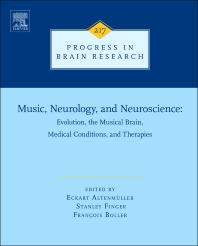
  • Music, Neurology, and Neuroscience: Evolution, the Musical Brain, Medical Conditions, and Therapies

    • 1st Edition
    • Volume 217
    • English
    Did you ever ask whether music makes people smart, why a Parkinson patient's gait is improved with marching tunes, and whether Robert Schumann was suffering from schizophrenia or Alzheimer's disease? This broad but comprehensive book deals with history and new discoveries about music and the brain. It provides a multi-disciplinary overview on music processing, its effects on brain plasticity, and the healing power of music in neurological and psychiatric disorders. In this context, the disorders the plagued famous musicians and how they affected both performance and composition are critically discussed, and music as medicine, as well as music as a potential health hazard are examined. Among the other topics covered are: how music fit into early conceptions of localization of function in the brain, the cultural roots of music in evolution, and the important roles played by music in societies and educational systems.