
Journals in Economics and finance
Journals in Economics and finance
Our Economics and Finance titles are essential reading for students, scholars, policymakers, and market practitioners who want to stay up-to-date with the latest research and foundational topics in the field, from financial markets and trade to e-commerce, econometrics, quantiative investing, financial technology, financial engineering, global finance, corporate finance, law and economics, macro and microeconomics, and risk management.
Titles manage to balance quality of content with the increasing demand for a wider view of the vast array of topics in the field of Economics and Finance.
International Journal of Greenhouse Gas Control
Carbon Capture — Transport — Utilization — StorageThe International Journal of Greenhouse Gas Control is a peer reviewed journal focusing primarily on Carbon Capture, Transport, Utilization & Storage. If your paper is not related to this area, it is not in scope for the Journal. The Journal invites research covering applied science and engineering advances in control of greenhouse gas emissions and reductions of their atmospheric concentrations through carbon dioxide capture, transport and storage. The Journal publishes results of experimental and pilot studies, technology demonstrations, process design and optimization, and techno-economic, policy, and life-cycle analyses relevant to applications in the power sector, major resource, manufacturing and production industries, and negative emissions technologies. Original research, review and comment papers are included.The scope of the journal (whilst not exclusive to) includes:CO2 captureNew research results relevant for large scale CO2 capture systems using chemical solvents, solid sorbents, chemical looping, calcium looping, membranes and membrane reactors and hybrid systems, PSA, cryogenics etc.Advances in CO2 capture processes (post combustion, pre combustion, oxy combustion) for power plants, cement and steel plants, refineries, petrochemicals, and other large industriesExperiment... results at pilot level from laboratory scale to demonstration, and relevant modelling work for scaling upCO2 capture process simulation for energy penalty reductions. Dynamic modelling.Cost analyses and cost reduction strategiesEnvironmen... impacts/risk, safety and life-cycle assessment of capture facilitiesCO2 TransportDesign and material/technical issues for CO2 transport systemsEconomic analyses and systems level optimization of CO2 transport systemsRisk assessments and safety issuesPermitting and regulatory issuesCO2 Geological storageGeological formation/storage capacity assessmentsMatching emissions sources and storage opportunitiesSite selection and characterizationMode... the fate and effects of stored CO2Integrity of the storage site, including caprocks and wellsTest injection research resultsRisk assessments and managementMonitoring tool developments and applicationsEnvironm... impact assessmentsDemonstra... project results and operational experiencesInduced seismicity, pressure maintenance, brine displacement, groundwater impactsRemediation and measurement, monitoring and verification issuesExperiences from natural/industrial analoguesAlternative storage optionsEx situ mineral carbonation (research results, safety/risk assessments, environmental/energy... issues, public acceptance, regulation and costs)Advanced weatheringOcean storageAlternative mitigation options/negative emission optionsBioCCS and other bioenergy mitigation optionsNegative emission accounting principlesComparison of different GHG mitigation options such as energy efficiency, renewables and nuclear power and their potential to reduce CO2 emissionsSystem integration and infrastructure developmentFlexibili... of operation of plants and on energy systems, integration issues, infrastructure development issues, financing and policiesImplementati... issuesLegal and regulatory developments/issuesH... capacity constraintsPublic awareness/acceptance issuesIndustry case studies on GHG mitigation technology implementation, learning by doing, knowledge transfer, stakeholder engagement and financing optionsIntegrated assessments, economic instruments that would induce commercial CCS deploymentEnergy and economic modelling of the role that CCS will play in the broader portfolio of emissions mitigation options under different scenariosAnalyses of policy options (national and international) to reduce GHG emissions and how these impact the commercial deployment of CCS systemsIf your paper is not related to Carbon Capture, Transport, Utilization & Storage, it is not in scope for the Journal.This journal welcomes contributions that support and advance the UN's sustainable development goals, in particular SDG 7 (Affordable and clean energy) and SDG 13 (Climate Action).- ISSN: 1750-5836

Structural Change and Economic Dynamics
Structural Change and Economic Dynamics publishes articles about theoretical and applied, historical and methodological aspects of structural change in economic systems. The journal publishes work analyzing dynamics and structural change in economic, technological, institutional and behavioral patterns. Articles might examine the effects of the incorporation of new technologies and infrastructures, aspects of international economic integration and development, the changing configuration of employment and income distribution, interdependence between environmental and economic change, instability and crisis. An important aim is to facilitate communication among researchers who are actively engaged in the study of the various aspects of structural change and the dynamics of economic systems from an analytical or policy point of view. SCED encourages articles that apply econometric and statistical techniques to the above themes. The journal also publishes pure theoretical research on the structural dynamics of economic systems, particularly in the fields of multisectoral, complex and dynamical analysis.- ISSN: 0954-349X

Japan and the World Economy
International Journal of Theory and PolicyThe increase in Japan's share of international trade and financial transactions has had a major impact on the world economy in general and on the U.S. economy in particular. The new economic interdependence between Japan and its trading partners created a variety of problems and so raised many issues that require further study.Japan and the World Economy will publish original research in economics, finance, managerial sciences, and marketing that express these concerns.Japan and the World Economy seeks to meet the growing need for comprehensive, impartial and scientific study of trade imbalance and friction, technological competition, internationalization of financial markets, exchange rate variation and macroeconomic coordination, comparative managerial and marketing practices and other related topics. Contributions are solicited from a broad-based, international community of scholars. In addition to empirical and policy-oriented studies, Japan and the World Economy also welcomes theoretical analysis that contributes to an understanding of the issues and proposes corrective action.- ISSN: 0922-1425

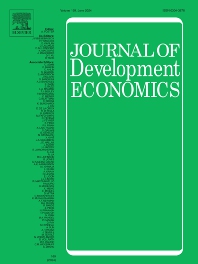
Journal of Development Economics
The Journal of Development Economics publishes original research papers relating to all aspects of economic development - from immediate policy concerns to structural problems of underdevelopment. The emphasis is on quantitative or analytical work, which is novel and relevant. The Journal does not publish book reviews. We welcome papers that take up questions in development economics that are of interest to the general readers of the journal, and then use data from a particular country or region to answer them. However, we do not publish articles that are essentially in-depth studies of a specific country, region, case, or event whose findings are unlikely to be of great interest to the general readers of the journal. In our review process we pre-screen all papers, some of which are immediately rejected. This includes papers that are not considered to be a good fit in terms of the topic or the methodology even though development is a broad field and sometimes this is a matter of subjective judgment. This also includes papers that fall short of our high standards, in terms of the contribution or value added to the literature, or in terms of methodological rigor. The Journal receives approx. 1300 papers per year and publishes only a small fraction (around 6-8%). To make this work in a timely fashion we only send 1/4 papers out for review. Given this volume we regret that we cannot provide explanations on our desk reject papers. Under normal circumstances, an author cannot submit (either s/he directly or through a co-author) more than three papers within any 12 month period. Papers that are once rejected by the JDE will not be considered for publication again, even if the authors use a new dataset or a new model. This is only possible if the editor in his or her decision letter explicitly leaves open this possibility. Special submissions:Register... Reports: The JDE offers authors the opportunity to have their prospective empirical projects reviewed and approved for publication before the results are known (referred to as 'Registered Reports'). This pre-results review track may be particularly suitable for authors working on research projects for which they have not yet collected or accessed data. Submissions in this track will follow existing policies outlined in the Author Information Pack, including the Mandatory Replication Policy, but specific information is available in the JDE Registered Reports Author Guidelines. A website including the Guidelines and information on Phase 1 acceptances to data is available here. To submit a Registered Report, select "Registered Report Stage I: Proposal" as the article type in the submission portal. "Registered Report Stage II: Full Article" should only be used for articles derived from accepted Stage I submissions.Short Papers: The JDE offers the authors a short-paper limited revision track. Submission guidelines follow AER: Insights. Manuscripts should be at most 6,000 words, with at most 5 exhibits (tables or figures). Online appendices of at most 20 pages are permitted, but manuscripts must be self-contained. Submissions will be desk rejected, rejected after review, or conditionally accepted. Decisions on refereed manuscripts generally occur within 6-8 weeks of initial submission, faster than for standard-length papers.To submit a short-format manuscript, select "Short Paper" as the article type in the submission portal. In addition to the direct submission process, the editors will also monitor standard-format rejections to identify manuscripts that would meet the journal's standards if they were rewritten in short format. In such cases, informed by the referee reports on the original standard-format submission, the Insights Co-editor will invite a new submission of the manuscript in short form, with a commitment to publish without further review if the authors follow a clear set of revision instructions.- ISSN: 0304-3878
International Journal of Industrial Organization
The Official Journal of The European Association for Research in Industrial Economics (EARIE)The International Journal of Industrial Organization (IJIO) is an international venture that aims at full coverage of theoretical and empirical questions in industrial organization. This includes classic questions of strategic behavior and market structure. The journal also seeks to publish articles dealing with technological change, internal organization of firms, regulation, antitrust and productivity analysis. We recognize the need to allow for diversity of perspectives and research styles in industrial organization and we encourage submissions in theoretical work, empirical work, and case studies. The journal will also occasionally publish symposia on topical issues.- ISSN: 0167-7187

Journal of Comparative Economics
Published on behalf of the Association for Comparative Economic StudiesThe mission of the Journal of Comparative Economics is to lead the new orientations of research in comparative economics. Before 1989, the core of comparative economics was the comparison of economic systems with in particular the economic analysis of socialism in its different forms. In the last fifteen years, the main focus of interest of comparative economists has been the transition from socialism to capitalism. In recent years, mostly as a result of the transition experience, a new orientation of comparative economics has emerged that focuses on the comparison of the economic effects of the various institutions of capitalism, be it in the legal sphere (common law versus civil law), in the political sphere (different types of democracies and electoral regimes) or in the sphere of culture, social norms, etc. This new orientation is a natural development following the very diverse experience of transitions from socialism to capitalism. The transition experience has indeed shown with a vengeance the importance of institutions in the process of economic development.Question... raised along these new orientations include: what institutions are critical (courts, credit markets, good regulations, etc) for successful growth?; how should institutions be measured (subjective surveys, particular laws on the books, etc); why are certain institutions, such as courts and regulatory culture, slow-moving while others, such as constitutions and electoral procedures, relatively fast-moving; why is there so much cross-sectional variance in the quality of institutions, and what kinds of initial conditions or historic natural experiments can be employed to estimate the causal impact of institutions on economic performance? The Journal of Comparative Economics will maintain its tradition of publishing the best papers on the Chinese economy and of being an important outlet for work on economies in Central Europe and the Former Soviet Union; the Journal of Comparative Economics aims to enlarge the interest of the journal to other emerging market economies.- ISSN: 0147-5967

Research in Economics
Established in 1947, Research in Economics is one of the oldest general-interest economics journals in the world and the main one among those based in Italy. The purpose of the journal is to select original theoretical and empirical articles that will have high impact on the debate in the social sciences; since 1947, it has published important research contributions on a wide range of topics.A summary of our editorial policy is this: the editors make a preliminary assessment of whether the results of a paper, if correct, are worth publishing. If so one of the associate editors reviews the paper: from the reviewer we expect to learn if the paper is understandable and coherent and - within reasonable bounds - the results are correct.We believe that long lags in publication and multiple demands for revision simply slow scientific progress. Our goal is to provide you a definitive answer within one month of submission. We give the editors one week to judge the overall contribution and if acceptable send your paper to an associate editor. We expect the associate editor to provide a more detailed evaluation within three weeks so that the editors can make a final decision before the month expires.In the (rare) case of a revision we allow four months and in the case of conditional acceptance we allow two months to submit the final version. In both cases we expect a cover letter explaining how you met the requirements. For conditional acceptance the editors will verify that the requirements were met. In the case of revision the original associate editor will do so. If the revision cannot be at least conditionally accepted it is rejected: there is no second revision.- ISSN: 1090-9443

European Economic Review
Established in 1969, European Economic Review is one of the oldest general-interest economics journals for all of Europe. It is intended as a primary publication for theoretical and empirical research in all areas of economics. The purpose of the journal is to select articles that will have high relevance and impact in a wide range of topics. All work submitted to the journal should be original in motivation or modelling and be capable of replication.- ISSN: 0014-2921

International Review of Economics Education
The International Review of Economics Education is dedicated to enhancing learning and teaching in the higher education economics community. It provides a forum for high quality research in the areas of curriculum design, pedagogy, assessment, teaching and learning innovation. The journal seeks to promote critical dialogue on educational theory and practice in economics and to demonstrate the relevance of research to good professional practice.Examples of issues that contributors are encouraged to focus on: • How do economics students learn? • What economics should be taught? • What are the constraints in improving economics teaching and learning? • How can current practice be improved? • How is economics taught internationally and what can we learn from this? • How can electronic learning technologies be used to improve student learning in economics?- ISSN: 1477-3880

Journal of Macroeconomics
Since its inception in 1979, the Journal of Macroeconomics has published theoretical and empirical articles that span the entire range of macroeconomics and monetary economics. More specifically, the editors encourage the submission of high quality papers that are concerned with the theoretical or empirical aspects of the following broadly defined topics: economic growth, economic fluctuations, the effects of monetary and fiscal policy, the political aspects of macroeconomics, exchange rate determination and other elements of open economy macroeconomics, the macroeconomics of income inequality, and macroeconomic forecasting.- ISSN: 0164-0704
