Books in Earth and planetary sciences

Elsevier's Earth and Planetary Sciences collection brings together pioneering research on the complexities of our planet and beyond. Covering topics from Earth's structural dynamics and ecosystems to planetary exploration, these titles support advancements in geoscience, environmental science, and space studies, offering essential insights for researchers, professionals, and students.

  • Seepage Hydraulics

    • 1st Edition
    • Volume 10
    • G. Kovács
    • English
  • Thermal Methods of Petroleum Production

    • 1st Edition
    • Volume 25
    • N.K. Baibakov + 2 more
    • English
    Until now, information on Russian enhanced oil recovery (EOR) research work and field experience has not been available in English. This work, originally published in Russian, describes in a systematic manner recent Russian laboratory and field research, as well as industrial experience of applying thermal EOR methods in different Russian oil fields - some with high viscosity crudes and others with low viscosity. It is written by two leading Russian specialists, and contains 116 diagrams (curves, graphs, designs), and 36 tables (research data).The book will be valuable to petroleum companies throughout the world, oil field servicing companies, petroleum engineering consultants, and libraries of technical institutes and universities.
  • Composition and Properties of Drilling and Completion Fluids

    • 6th Edition
    • Ryen Caenn + 2 more
    • English
    The petroleum industry in general has been dominated by engineers and production specialists. The upstream segment of the industry is dominated by drilling/completion engineers. Usually, neither of those disciplines have a great deal of training in the chemistry aspects of drilling and completing a well prior to its going on production. The chemistry of drilling fluids and completion fluids have a profound effect on the success of a well. For example, historically the drilling fluid costs to drill a well have averaged around 7% of the overall cost of the well, before completion. The successful delivery of up to 100% of that wellbore, in many cases may be attributable to the fluid used. Considered the "bible" of the industry, Composition and Properties of Drilling and Completion Fluids, first written by Walter Rogers in 1948, and updated on a regular basis thereafter, is a key tool to achieving successful delivery of the wellbore. In its Sixth Edition, Composition and Properties of Drilling and Completion Fluids has been updated and revised to incorporate new information on technology, economic, and political issues that have impacted the use of fluids to drill and complete oil and gas wells. With updated content on Completion Fluids and Reservoir Drilling Fluids, Health, Safety & Environment, Drilling Fluid Systems and Products, new fluid systems and additives from both chemical and engineering perspectives, Wellbore Stability, adding the new R&D on water-based muds, and with increased content on Equipment and Procedures for Evaluating Drilling Fluid Performance in light of the advent of digital technology and better manufacturing techniques, Composition and Properties of Drilling and Completion Fluids has been thoroughly updated to meet the drilling and completion engineer's needs.
  • Earth's Magnetosphere

    Formed by the Low-Latitude Boundary Layer
    • 1st Edition
    • Walter Heikkila
    • English
    The author argues that, after five decades of debate about the interactive of solar wind with the magnetosphere, it is time to get back to basics. Starting with Newton's law, this book also examines Maxwell's equations and subsidiary equations such as continuity, constitutive relations and the Lorentz transformation; Helmholtz' theorem, and Poynting's theorem, among other methods for understanding this interaction.
  • Extractive Metallurgy of Copper

    • 5th Edition
    • Mark E. Schlesinger + 2 more
    • English
    This multi-author new edition revises and updates the classic reference by William G. Davenport et al (winner of, among other awards, the 2003 AIME Mineral Industry Educator of the Year Award "for inspiring students in the pursuit of clarity"), providing fully updated coverage of the copper production process, encompassing topics as diverse as environmental technology for wind and solar energy transmission, treatment of waste by-products, and recycling of electronic scrap for potential alternative technology implementation. The authors examine industrially grounded treatments of process fundamentals and the beneficiation of raw materials, smelting and converting, hydrometallurgical processes, and refining technology for a mine-to-market perspective - from primary and secondary raw materials extraction to shipping of rod or billet to customers. The modern coverage of the work includes bath smelting processes such as Ausmelt and Isasmelt, which have become state-of-the-art in sulfide concentrate smelting and converting.
  • Developments in Palygorskite-Sepiolite Research

    A New Outlook on these Nanomaterials
    • 1st Edition
    • Volume 3
    • English
    The aim of this comprehenvise book is to present the most important results achieved in the research of the clay minerals palygorskite and sepiolite. Palygorskite and sepiolite have found to be useful in a huge variety of industrial and medical applications. As a result, research on these clays has been intensified during the last two decades, and important advances in their characterization have been made. The book contains contributions from distinguished scientists in the field.
  • Quaternary Glaciations - Extent and Chronology

    A Closer Look
    • 1st Edition
    • Volume 15
    • J. Ehlers + 2 more
    • English
    The book presents an up-to-date, detailed overview of the Quaternary glaciations all over the world, not only with regard to stratigraphy but also with regard to major glacial landforms and the extent of the respective ice sheets. The locations of key sites are included. The information is presented in digital, uniformly prepared maps which can be used in a Geographical Information System (GIS) such as ArcView or ArcGIS. The accompanying text supplies the information on how the data were obtained (geomorphology, geological mapping, air photograph evaluation, satellite imagery), how the features were dated (14C, TL, relative stratigraphy) and how reliable they are supposed to be. All references to the underlying basic publications are included. Where controversial interpretations are possible e.g. in Siberia or Tibet, this is pointed out. As a result, the information on Quaternary glaciations worldwide will be much improved and supplied in a uniform digital format.The information on the glacial limits is compiled in digital form by the coordinators of the project, and is available for download at: http://booksite.else...
  • Physical Properties of Rocks

    A Workbook
    • 1st Edition
    • Volume 8
    • Juergen H. Schön
    • English
    Physical Properties of Rocks: A Workbook is a symbiosis of a brief description of physical fundamentals of rock properties (based on typical experimental results and relevant theories and models) with a guide for practical use of different theoretical concepts. For this purpose a companion web site contains a selection of model based equations in excel worksheets for practical application and training by the user to work with his own data (or to ''play" in order to demonstrate the effects of various input information and to demonstrate the effects of various input information in petrophysical work. In two special chapters the problem of relationships between petrophysical parameters based on various model concepts is presented as a foundation for combined interpretation. This part also contains the author's 'structured model'. The workbook is a result of the more than 40 years experience of the author in teaching at universities and industrial courses.
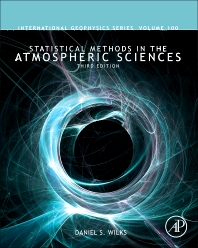
  • Statistical Methods in the Atmospheric Sciences

    • 3rd Edition
    • Volume 100
    • Daniel S. Wilks
    • English
    Statistical Methods in the Atmospheric Sciences, Third Edition, explains the latest statistical methods used to describe, analyze, test, and forecast atmospheric data. This revised and expanded text is intended to help students understand and communicate what their data sets have to say, or to make sense of the scientific literature in meteorology, climatology, and related disciplines. In this new edition, what was a single chapter on multivariate statistics has been expanded to a full six chapters on this important topic. Other chapters have also been revised and cover exploratory data analysis, probability distributions, hypothesis testing, statistical weather forecasting, forecast verification, and time series analysis. There is now an expanded treatment of resampling tests and key analysis techniques, an updated discussion on ensemble forecasting, and a detailed chapter on forecast verification. In addition, the book includes new sections on maximum likelihood and on statistical simulation and contains current references to original research. Students will benefit from pedagogical features including worked examples, end-of-chapter exercises with separate solutions, and numerous illustrations and equations. This book will be of interest to researchers and students in the atmospheric sciences, including meteorology, climatology, and other geophysical disciplines.
  • The Copenhagen Diagnosis

    Updating the World on the Latest Climate Science
    • 1st Edition
    • 26 Leading Scientists
    • English
    The Copenhagen Diagnosis is a summary of the global warming peer reviewed science since 2007. Produced by a team of 26 scientists led by the University of New South Wales Climate Research Centre, the Diagnosis convincingly proves that the effects of global warming have gotten worse in the last three years. It is a timely update to the UN’s Intercontinental Panel on Climate Change 2007 Fourth Assessment document (IPCC AR4). The report places the blame for the century long temperature increase on human factors and says the turning point "must come soon". If we are to limit warming to 2 degrees above pre-industrial values, global emissions must peak by 2020 at the latest and then decline rapidly. The scientists warned that waiting for higher levels of scientific certainty could mean that some tipping points will be crossed before they are recognized. By 2050 we will effectively need to be in a post-carbon economy if we are to avoid unlivable temperatures. Authors: Ian Allison, Nathaniel Bindoff, Robert Bindschadler, Peter Cox, Nathalie de Noblet-Ducoudre´, Matthew England, Jane Francis, Nicolas Gruber, Alan Haywood, David Karoly, Georg Kaser, Corinne Le Que´re´, Tim Lenton, Michael Mann, Ben McNeil, Andy Pitman, Stefan Rahmstorf, Eric Rignot, Hans Joachim Schellnhuber, Stephen Schneider, Steven Sherwood, Richard Somerville, Konrad Steffen, Eric Steig, Martin Visbeck, Andrew Weaver