Books in Financial economics

Delve into the mechanisms of financial markets, asset valuation, and risk management with this extensive portfolio. Supporting finance professionals, researchers, and students, it features advanced theories, empirical research, and practical applications in banking, investments, and financial regulation. These resources foster better understanding of market dynamics, stability, and innovation in the evolving financial landscape.

  • Contemporary Financial Intermediation

    • 5th Edition
    • Stuart I. Greenbaum + 1 more
    • English
    Contemporary Financial Intermediation, Second Edition, brings a unique analytical approach to the subject of banks and banking. This completely revised and updated edition expands the scope of the typical bank management course by addressing all types of deposit-type financial institutions, and by explaining the why of intermediation rather than simply describing institutions, regulations, and market phenomena. This analytic approach strikes at the heart of financial intermediation by explaining why financial intermediaries exist and what they do. Specific regulations, economies, and policies will change, but the underlying philosophical foundations remain the same. This approach enables students to understand the foundational principles and to apply them to whatever context they encounter as professionals. This book is the perfect liaison between the microeconomics realm of information economics and the real world of banking and financial intermediation. This book is recommended for advanced undergraduates and MSc in Finance students with courses on commercial bank management, banking, money and banking, and financial intermediation.
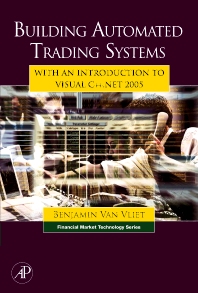
  • Building Automated Trading Systems

    With an Introduction to Visual C++.NET 2005
    • 1st Edition
    • Benjamin Van Vliet
    • English
    Over the next few years, the proprietary trading and hedge fund industries will migrate largely to automated trade selection and execution systems. Indeed, this is already happening. While several finance books provide C++ code for pricing derivatives and performing numerical calculations, none approaches the topic from a system design perspective. This book will be divided into two sections: programming techniques and automated trading system ( ATS ) technology and teach financial system design and development from the absolute ground up using Microsoft Visual C++.NET 2005. MS Visual C++.NET 2005 has been chosen as the implementation language primarily because most trading firms and large banks have developed and continue to develop their proprietary algorithms in ISO C++ and Visual C++.NET provides the greatest flexibility for incorporating these legacy algorithms into working systems. Furthermore, the .NET Framework and development environment provide the best libraries and tools for rapid development of trading systems. The first section of the book explains Visual C++.NET 2005 in detail and focuses on the required programming knowledge for automated trading system development, including object oriented design, delegates and events, enumerations, random number generation, timing and timer objects, and data management with STL.NET and .NET collections. Furthermore, since most legacy code and modeling code in the financial markets is done in ISO C++, this book looks in depth at several advanced topics relating to managed/unmanaged/CO... memory management and interoperability. Further, this book provides dozens of examples illustrating the use of database connectivity with ADO.NET and an extensive treatment of SQL and FIX and XML/FIXML. Advanced programming topics such as threading, sockets, as well as using C++.NET to connect to Excel are also discussed at length and supported by examples. The second section of the book explains technological concerns and design concepts for automated trading systems. Specifically, chapters are devoted to handling real-time data feeds, managing orders in the exchange order book, position selection, and risk management. A .dll is included in the book that will emulate connection to a widely used industry API ( Trading Technologies, Inc.’s XTAPI ) and provide ways to test position and order management algorithms. Design patterns are presented for market taking systems based upon technical analysis as well as for market making systems using intermarket spreads. As all of the chapters revolve around computer programming for financial engineering and trading system development, this book will educate traders, financial engineers, quantitative analysts, students of quantitative finance and even experienced programmers on technological issues that revolve around development of financial applications in a Microsoft environment and the construction and implementation of real-time trading systems and tools.
  • International Taxation Handbook

    Policy, Practice, Standards, and Regulation
    • 1st Edition
    • Greg N. Gregoriou + 1 more
    • English
    International taxation is evolving in response to globalization, capital mobility, and the increased trade in services, and introduces international tax practitioner, student and researcher to the theory, practice, and international examples of the changing landscape. Models of tax competition in a flat and connected world are very different than those necessary to ensure compliance in a world dominated by cross-border flows of goods and repatriation of profits. Taxes on consumption, e-commerce, and services are looming innovations in future of international taxation. Tax coordination and standardization are immense challenges in a world in which the movement of value is increasingly subtle and hard to detect. And as corporations and individuals become more sophisticated in the internationalization of flows of capital, our models must become more sophisticated in their scope and inclusion.In the era when trade was dominated by the exchange of manufactured goods, international taxation was designed to protect domestic industries, create tax revenue, prevent evasion, and promote compliance. The traditional toolbox of customs duties, tariffs, and taxes on repatriated profits must be augmented as the movement of goods across borders represents a much smaller fraction of trade and as international taxation policy is increasingly used to attract foreign corporations rather than discourage branch offices. International taxation models that can better tax services, track international flows of capital, and allow a nation to compete in a world market for capital formation are the tools of the modern tax practitioner. International tax policy is now viewed as an integral part of economic policy. This approach is bound to accelerate as the world becomes increasingly flat and better connected. Economic progress is more and more influenced by the movement of services and information, movements that are no longer through ports but through fiber optic lines. This book contributes to the growing literature on international taxation by bringing together theory and experience, current practices and innovation, and our current understanding of some of the challenges now facing and arguably frustrating current international taxation policy. The book will create new avenues of research for scholars, a new awareness for students of International Taxation, and new possibilities for international tax practitioners. The models and examples presented here suggest that there are serious problems with measurability of flows of services and information, and points to an increasingly need for greater harmonization of international taxation, perhaps through coordinated consumption-tax oriented approaches.
  • Value at Risk and Bank Capital Management

    Risk Adjusted Performances, Capital Management and Capital Allocation Decision Making
    • 1st Edition
    • Francesco Saita
    • English
    Value at Risk and Bank Capital Management offers a unique combination of concise, expert academic analysis of the latest technical VaR measures and their applications, and the practical realities of bank decision making about capital management and capital allocation. The book contains concise, expert analysis of the latest technical VaR measures but without the highly mathematical component of other books. It discusses practical applications of these measures in the real world of banking, focusing on effective decision making for capital management and allocation. The author, Francesco Saita, is based at Bocconi University in Milan, Italy, one of the foremost institutions for banking in Europe. He provides readers with his extensive academic and theoretical expertise combined with his practical and real-world understanding of bank structure, organizational constraints, and decision-making processes. This book is recommended for graduate students in master's or Ph.D. programs in finance/banking and bankers and risk managers involved in capital allocation and portfolio management.
  • Fundamentals of Fund Administration

    A Guide
    • 1st Edition
    • David Loader
    • English
    Fundamentals of Fund Administration fills a gap in the lack of books that cover the administration and operations functions related to funds. With the growth of hedge funds globally there is more and more requirement for fund administration services, and the success of the fund administration is crucial to the success of the funds themselves in a highly competitive market. As the focus on operational risk, cost effective support and administration of trading and investment and the ability to design, develop and deliver added-value services for clients grows there is a need for a comprehensive analysis of what happens from trade to settlement and beyond and the exact role that the fund administrator may be required to provide. The book helps those responsible for managing and supervising fund administration services by examining the decisions, actions and problems at the various stages as well as explaining the products and infrastructure that services support.
  • Handbook of Management Accounting Research

    • 1st Edition
    • Volume 2
    • Christopher S. Chapman + 2 more
    • English
    Volume two of the Handbooks of Management Accounting Research consists of two groups of chapters. The first draw together research that has focussed on particular management accounting practices. The second set synthesise contributions to the literature that have been focussed within particular organisational contexts. Volume two concludes with a review of research on how management accounting practice and research varies around the world. Special pricing available if purchased as a set with Volume 1.
  • China's Financial Markets

    An Insider's Guide to How the Markets Work
    • 1st Edition
    • Salih N. Neftci + 1 more
    • English
    China’s financial markets represent about $2 trillion and are expected to grow to about $10 trillion by 2008. As these markets continue to open to outside investment, a thorough understanding of how they operate will be essential for success. In this book, Salih Neftci, an expert in finance whose teaching and research span North America, Europe and Asia, and Michelle Menager-Xu, a Chinese finance professional currently working in Geneva, bring together an unprecedented collection of Chinese insiders who are experts in their respective industries. These experts provide a detailed description of the banking system, the money, equity, futures, FX, and bond markets, the insurance sector, the mortgage market and mortgage instruments, and the regulators. Readers will learn how each of these financial sectors operates, how the government, regulators, and the central bank are involved, each sector’s history, size and projected growth, an analysis of its current situation and discussion of future trends, the major players, and how the game is played. This is a must-read book for financial success in this emerging market.
  • Stress Testing for Risk Control Under Basel II

    • 1st Edition
    • Dimitris N. Chorafas
    • English
    The Consultative paper issued by the Basel Committee on Banking Supervision (Basel II) cites the failure of bankers to adequately stress test exposures as a major reason for bad loans. Sample quotes from this crucial document: * "Banks should take into consideration potential future changes in economic conditions when assessing individual credits and their credit portfolios, and should assess their credit risk exposures under stressful conditions." * "The recent disturbances in Asia and Russia illustrate how close linkages among emerging markets under stress conditions and previously undetected correlations between market and credit risks, as well as between those risks and liquidity risk, can produce widespread losses."* "Effective stress testing which takes account of business or product cycle effects is one approach to incorporating into credit decisions a fuller understanding of a borrower's credit risk."Written for professionals in financial services with responsibility for IT and risk measurement, management, and modeling, Dimitris Chorafas explains in clear language the testing methodology necessary for risk control to meet Basel II requirements. Stress testing is the core focus of the book, covering stress analysis and the use of scenarios, models, drills, benchmarking, backtesting, and post-mortems, creditworthiness, wrong way risk and statistical inference, probability of default, loss given default and exposure at default, stress testing expected losses, correlation coefficients, and unexpected losses, stress testing related to market discipline and control action, and pillars 2 and 3 of Basel II.
  • Venture Capital in Europe

    • 1st Edition
    • Greg N. Gregoriou + 2 more
    • English
    Until recently, only the United States had an active venture capital market. This is changing rapidly, as many other countries have experienced rapid growth in venture capital financing over the past five years. This book contains new scientific articles showcasing the latest research on venture capital in Europe. Venture capital investment remains a hot topic with portfolio managers, individual investors, academics worldwide. This book examines in detail all the major issues regarding venture capital investment: contracting, financing, regulation, valuation, etc. and identifies new trends in the venture capital arena. Features a foreword by Josh Lerner.
  • Market Data Explained

    A Practical Guide to Global Capital Markets Information
    • 1st Edition
    • Marc Alvarez
    • English
    Market Data Explained is intended to provide a guide to the universe of data content produced by the global capital markets on a daily basis. Commonly referred to as “market data”, the universe of content is very wide and the type of information correspondingly diverse. Jargon and acronyms are very common. As a result, users of marker data typically face difficulty in applying the content in analysis and business applications. This guide provides an independent framework for understanding this diversity and streamlining the process of referring to content and how it relates to today’s business environment. The book achieves this goal by providing a consistent frame of reference for users of market data. As such, it is built around the concept of a data model – a single, coherent view of the capital markets independent of any one source, such as an exchange. In particular it delineates clearly between the actual data content and how it is delivered (i.e., realtime data streams versus reference data). It shows how the data relates across the universe of securities (i.e., stocks, bonds, derivatives etc.). In this way it provides a logical framework for understanding how new content can be added over time as the business develops. Special features:1. Uniqueness – this is the first comprehensive catalog and taxonomy to be made available for a business audience2. Industry Acceptance – the framework described in this book is implemented as a relational data model in the industry today and used by blue chip multinational firms3. Comprehensiveness – there are no arbitrary distinctions made based on asset class or data type (the legacy approach). The model presented in this book is fully cross asset and makes no distinction between data types (i.e., realtime versus historical/reference data) or sources4. Independence – the framework is an independent, objective overview of how the data content integrates to provide a coherent view of the data produced by the global capital markets on a daily and intra-day basis. It provides a logical framework for referring to the content and entities that are so intrinsic to this industry