Journals in Transportation
Journals in Transportation
Travel Behaviour and Society
Travel Behaviour and Society is an interdisciplinary journal publishing high-quality original papers which report leading edge research in theories, methodologies and applications concerning transportation issues and challenges which involve the social and spatial dimensions. In particular, it provides a discussion forum for major research in travel behaviour, transportation infrastructure, transportation and environmental issues, mobility and social sustainability, transportation geographic information systems (TGIS), transportation and quality of life, transportation data collection and analysis, etc.Under the broad theme of transportation issues and challenges which involve social and spatial dimensions, the following areas are targeted for papers to be published in the journal:Transportati... geographic information systems (TGIS)Transportation data collection, surveys and global positioning systems (GPS)Activity-based approach to travel behaviour analysis and modellingTransportat... infrastructureTransi... developmentTransport... and quality of lifeTransportation and climate changeTransportation and low carbon lifestyleTransportat... and social sustainabilityInterf... of transportation and telecommunicationsAn official journal of the Hong Kong Society for Transportation StudiesPlease do not contact the Editors directly about your manuscript as they handle a large number of submissions and unfortunately cannot answer such requests. Please read the Guide for Authors carefully (eg, about changes to authorship) and use the Track your submission option for status-check purpose. For other inquiries, please reach out to [email protected] or [email protected]... Please be assured that the support team will alert the concerned Editors accordingly and the Editors will take further actions, as appropriate.- ISSN: 2214-367X

Artificial Intelligence for Transportation
Artificial Intelligence for Transportation is a peer-reviewed journal dedicated to advancing the integration of machine learning (ML) and artificial intelligence (AI) into the field of transportation. The journal focuses on innovative research that leverages AI and ML to address critical challenges in understanding, designing, planning, operating, and managing sustainable, safe, and efficient multimodal transportation systems.Emphasizing the development of AI-empowered solutions, the journal seeks contributions that enhance transportation system performance in terms of safety, efficiency, reliability, equity, accessibility, and environmental sustainability. Interdisciplinary research is highly encouraged, particularly work that integrates cutting-edge AI technologies, such as deep learning, reinforcement learning, large language models, with conventional methodologies, e.g. operations research, probabilistic modeling, etc., to tackle complex transportation challenges.Artificia... Intelligence for Transportation strongly supports open science initiatives, promoting the publication of reproducible research and the sharing of large-scale datasets through online repositories. The journal places special emphasis on studies demonstrating the scalability and transferability of AI-empowered solutions across diverse transportation contexts and geographies.- ISSN: 3050-8606

Analytic Methods in Accident Research
Analytic Methods in Accident Research publishes manuscripts that deal with the development and/or application of innovative statistical and econometric methods to the study of vehicle crashes and other transportation and non-transportation-r... accidents. The intent of the journal is to demonstrate how such innovative methodological approaches can be used to provide new insights and quantification of the factors that affect the frequency and severity of accidents - thus providing new guidance for the implementation of appropriate countermeasures. While the focus of the journal is on the underlying analytic approach, acceptable application areas include all elements of transportation safety (road, pedestrian, air, rail, and water safety), construction safety, and any area of study where the unintended consequences of human behavior, machine failures or system failures result in property damage and/or bodily injury.- ISSN: 2213-6657

Transportation Research Part D: Transport and Environment
Transportation Research Part D: Transport and Environment publishes original research on the environmental impacts of transportation, policy responses to those impacts, and their implications for the design, planning, and management of transportation systems. It covers broad aspects of the interaction between transportation and the environment, ranging from the environmental effects of a local transportation system to global implications of natural resource depletion and atmospheric pollution.The journal invites submissions of research papers that analyze broad environmental impacts from all existing and emerging modes of both passenger and freight transportation. Papers dealing with transportation infrastructure and the environment are also considered. The emphasis of the journal is on original scientific findings and innovative policy responses of a regulatory, planning, technical or fiscal nature. Articles should demonstrate generalizable policy and methodological relevance to research and practice. Submissions of an interdisciplinary nature are encouraged and should appeal to readers from a wide range of disciplines. TRD includes a section focusing on Disasters and Resilience with its own dedicated Section Editors. Transportation plays a critical role in the resilience of communities. Disasters are unexpected, low probability events which can overwhelm the capacity of systems to function and provide vital services supporting human health, environmental quality, and economic and social livelihoods. Transportation systems are essential to effective disaster response, relief, recovery, and mitigation. This section of TRD encourages transportation researchers from multiple disciplines to address the critical ways in which transportation science and the supporting theories, methods, and tools can be applied to increase societal resilience against all hazards, both natural and man-made.- ISSN: 1361-9209

Transportation Research Part E: Logistics and Transportation Review
Transportation Research Part E: Logistics and Transportation Review (TR-E) is differentiated from its sister journals (TR-A, TR-B, TR-C, TR-D, and TR-F). As reflected in their title, the commonality between these journals is the focus on ‘Transportation,’ but TR-E is differentiated by specializing in ‘Logistics.’ Of course, it is widely accepted that transportation is undoubtedly one of the most critical components of logistics. TR-E publishes informative and high-quality articles drawn from across the spectrum of logistics components. The related research studies are multi-disciplinary and include (i) hard/ classic logistics research, such as transportation, material handling, packaging, warehousing, inventory, and handling, and so on (ii) soft logistics research by adding Operations Management (OM) and Supply Chain Management (SCM) concepts, tools, and philosophies to the classic logistics, such as sustainability, risk and disruption, circular economy, and artificial intelligence.There are no limitations to the research methods utilized. Therefore, various research methods can be used, such as analytical (e.g., operations research techniques including game theory, queuing theory, dynamic programming, linear, integer, and nonlinear programming), quantitative and qualitative empirical research (e.g., time series, regression, microeconomics), simulation, mixed research methods (e.g., combining surveys and case studies with quantitative data analysis), experimental research (e.g., controlled experiments, lab experiments, and field experiments), case studies (e.g., in-depth analysis), machine learning, artificial intelligence and network analysis (e.g., graph theoretic concept).- ISSN: 1366-5545

Case Studies on Transport Policy
A Journal of the World Conference on Transport Research SocietyTransport policy is a multidisciplinary field where engineering, economics, sociology and law must come together in well-articulated and effective solutions. Despite being a field of effective intervention, most scientific publications address transport policy with a theoretical and often abstract approach, making its understanding difficult for non-senior academics and even more opaque for practitioners. While the merits of case study methods both for undergraduate and graduate teaching are recognised, academics struggle to find empirical material that provides objective and operational illustration of the theories and approaches lectured. This is a major barrier not only in the teaching context but also for practitioners.Case Studies on Transport Policy covers this gap by providing a repository of relevant material to support teaching and transferability of experiences. Observation of field experience highlighting the details and drawbacks of implementation is invaluable to show how Transport Policy can be applied in the operational field, maintaining consistency with strategic options. Teaching with case studies introduces students to challenges they may face in the real world, and provides a very rich learning method for executive training at every institutional level. For practitioners, and specially governments, case studies are a powerful tool to show the potential benefits from policy measures and packages.Case Studies on Transport Policy and its sister journal Transport Policy provide a valuable reference for the specialised study of transport policy offering in-depth theoretical analysis and detailed case study description and analysis, and in this way providing very complete material for decision makers planners and practitioners to undertake transferability of experiences.- ISSN: 2213-624X

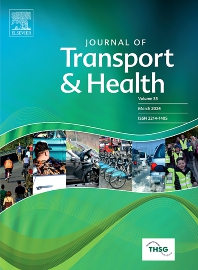
Journal of Transport & Health
The Journal of Transport & Health (JTH) is devoted to publishing research that advances our knowledge on the many interactions between transport and health and the policies that affect these. In general, we will prioritise papers that evaluate or inform the development of interventions and policies to improve population health, or that make a genuinely original contribution, rather than being basic descriptive studies. The journal aims to cover transport and health issues in all countries; in general, studies should have a context, or lessons, that can be transferred to other locations. Interactions between transport and health include, for instance:the impacts on public health and inequalities of:active modes of transport;noise and air pollution generated by transport;road travel injuries (see below);community severance;road danger and its reduction (see below):actual safety and security hazards associated with transport;perception... of danger and factors affecting these;factors affecting transport choices:urban form;location and accessibility of health and other facilities;age, gender, health and disability;socio-eco... inequalities;ruralit... travel;synergies between sustainability and health impacts of transport;economic and health impact assessmentsmethodolo... advances, including considerations of complex systems; andpolicies and interventions that promote or discourage healthy and sustainable transport modes, transport systems and communities (see below).We wish the Journal of Transport & Health to publish articles at the cutting-edge that are significant for policy and practice. The readership is international and multi-disciplinary; articles need to be understood by intelligent readers from a broad range of specialties and places. We are particularly keen to encourage submissions that are cross-disciplinary or inter-disciplinary. The journal has three particular aims:to promote dialogue and collaboration between the two research communities it serves;to improve the methods and the quality and appropriate use of data to better understand the relationships between transport and health; andto encourage transfer of research into practice.Is my manuscript in scope for Journal of Transport & Health?The journal's original scope remains largely unchanged, but with the experience of the past few years, we now offer more guidance for articles about active travel (walking and cycling, including to/from public transport [transit]) and road travel collisions and injury. We seek papers that advance our knowledge or use innovative designs and analyses that expand and contribute significantly to an already established literature.Active TravelThere is a well-established connection between active travel, primarily walking and cycling, and population health. We are looking for innovative designs and analyses that expand and contribute significantlyto an already established literature.We encourage submission of papers that evaluate or inform the development of interventions and policies to improve population health or that make a genuinely original contribution, rather than being basic, descriptive studies, even if from countries without previous published papers on the topic.In general, we will no longer consider cross-sectional analyses of children's school travel, even if yours is the first such study in a particular location. Studies producing substantial, transferable new information may be considered.Road travel injuries (fatal and non-fatal)There are many journals that focus on transport crashes and injuries, any unintentional injuries, and engineering; we do not wish to duplicate these. We are therefore restricting the scope of our journal to those that are more public health-focused, are more cross-disciplinary, and do not have an engineering or laboratory basis.We will no longer consider manuscripts that relate to collisions or crash severity that have little or no health focusWe will continue to consider manuscripts that focus on:road travel injuries, both fatal and non-fatal, and their long-term health consequences; andsocial and environmental determinants of road travel injury and health outcomes (acute and/or chronic).In general, we will not consider manuscripts where numbers are used rather than rates when exploring associations with danger or safety, whether as a cross-sectional association or in longitudinal studies examining change. The fact that more people are injured where, or when, more people travel is not very enlightening.In countries without suitable travel-related denominator data (distances travelled, time spent travelling, or number of trips), population-based denominators will be accepted. For example, when describing the proportion of casualties by age or by travel mode, it is important to compare those with the proportions in the general population.We require all authors to avoid the word 'accident' except where it is in the reference of a document they are citing. Although it means 'unintentional', it is often interpreted as meaning 'unavoidable'. More importantly, 'accident' is sometimes used to refer to the event (crash/collision/fal... and sometimes to the consequence (casualty/injury/fat... It is not always clear which is meant. See BMJ 2001;322:1320 for a longer explanation.Your manuscript is definitely not suitable for the Journal of Transport and Health if it does not focus on transport and health.Your manuscript is probably unsuitable for the Journal of Transport & Health:it is full of acronyms; orthere are three or more pages of formulae.- ISSN: 2214-1405
Latin American Transport Studies
Latin American Transport Studies (LATS) is a refereed international journal published by Elsevier in collaboration with the Panamerican Society for Transport and Logistics Research (PANAMSTR). LATS aims at providing useful insights into solving Latin American transport-related issues from both theoretical and practical perspectives. It treats all types of transport modes and all issues in the transport sector. While papers dealing with issues specific to Latin America are especially welcome, other papers related to transportation studies are also within the scope of this journal.The Panamerican Society for Transport and Logistics Research, PANAMSTR, promotes academic and research activities in the area of transport, transit and logistics. It works to strengthen scientific capacity and academic exchange from a multimodal, multisectoral, and multidisciplinary perspective.- ISSN: 2950-0249
